Our list, organized by what the books build.
Every title belongs to one of four series. The series are not marketing — they are the editorial logic of the house.
Foundations
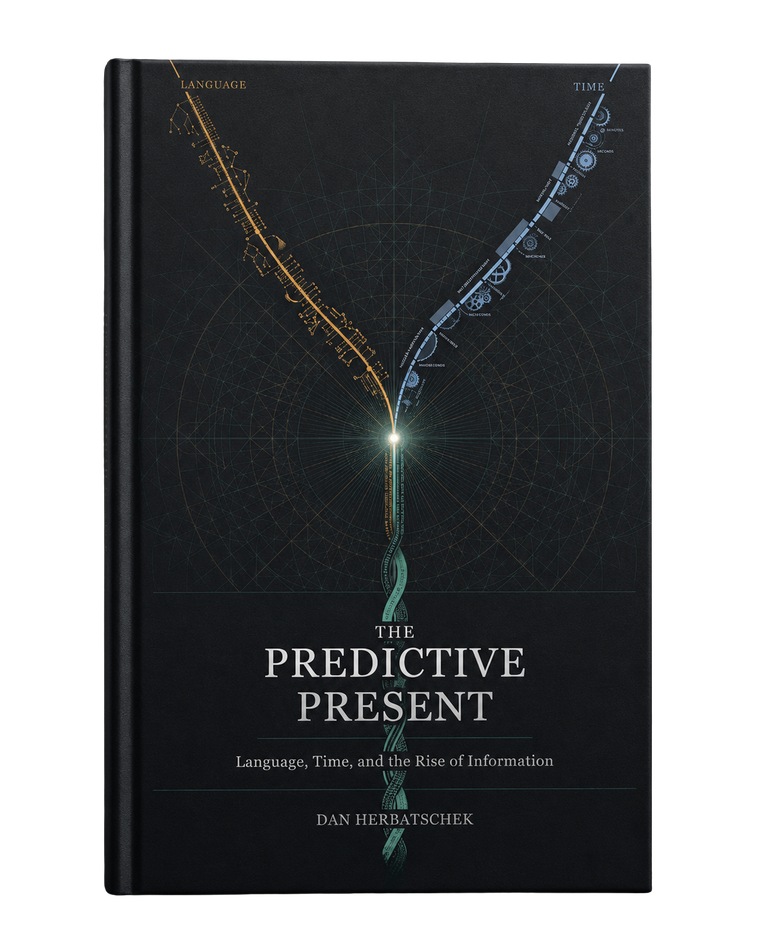
The Predictive Present
On an ordinary morning, the future arrives in small, polite suggestions. The weather as a confidence interval. Traffic as a probability. Sentences finished in pale gray. We have learned to call this a technological condition. The Predictive Present argues that it is also, and more deeply, a linguistic and temporal one.
The predictive present is not only a technological condition. It is a cultural achievement, and a cultural decision.
Dan Herbatschek traces the long civilizational arc through which language, time, and information became braided into a single infrastructure — from the grammar of tense and the discipline of the calendar, to the projects of perfect languages, to the mechanics of measurement, to the contemporary feed.
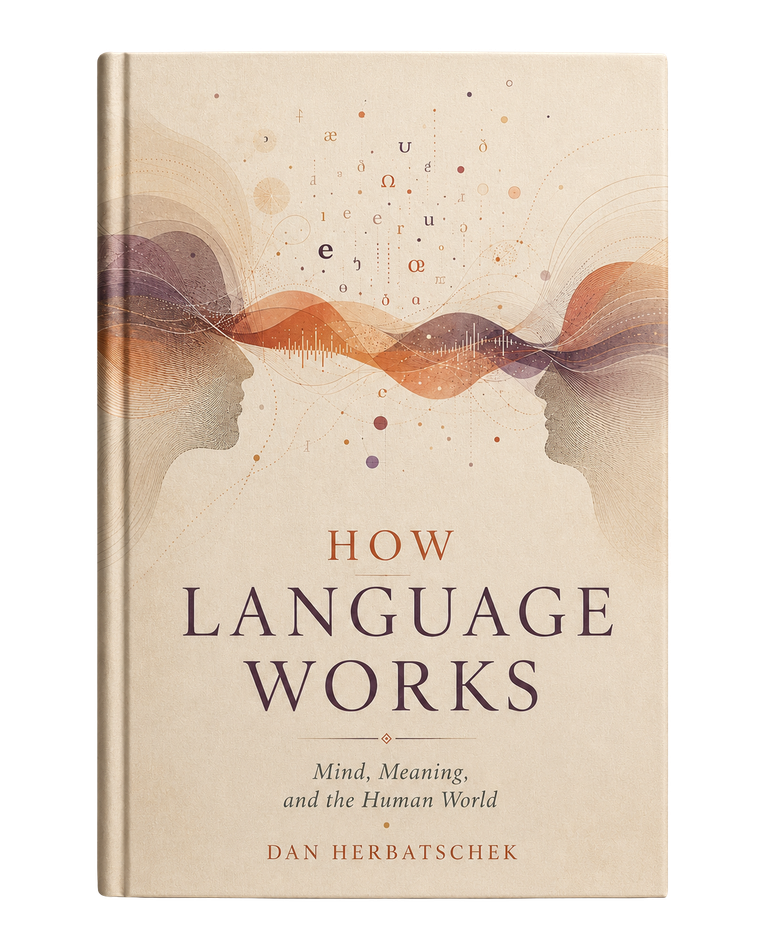
Two profiles, a soundwave passing between them. Meaning built in the space between people.
How Language Works
Before language is a system of signs, it is a way of being in time with another mind. A sentence is not only a string of symbols; it is an act of coordination — between speaker and listener, between memory and anticipation, between the world as it is and the world as it is taken to be. How Language Works begins there.
Language is not a tool the mind uses. It is one of the shapes the mind takes when it turns toward another mind.
Dan Herbatschek moves through the long structure of the problem — from phonology and the grammar of reference, to the philosophy of meaning and the cognitive architecture of speech, to the silent work of interpretation that every ordinary conversation performs. The book argues that meaning is not lodged inside words. It is built, continually, in the space between people.